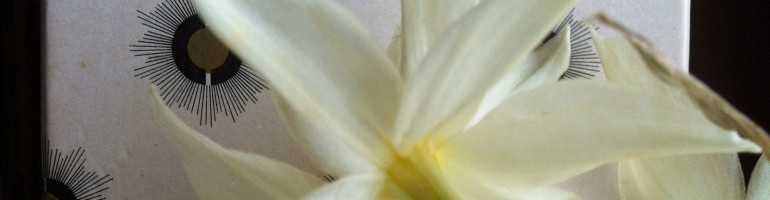


There is something almost irritatingly predictable in the annual punctuality of Japanese osmanthus. I will be walking along, and will suddenly catch its fresh, early, blooming in the air, unexpectedly, ( I always forget ), and then, ask myself the date. Ah yes, October first. Or, perhaps, sometimes, October the second. Always one of these. But whatever the date, the flowers, like Japanese trains, come out like clockwork, and for the next two weeks you are drowsed, almost suffocated, in that canned-peach, alluringly autumnal smell of apricots, orange peel, and delicate white flowers.
Two years ago, post-earthquake, we moved to this house, which just happens to have the biggest osmanthus tree in the entire neighbourhood. If you are an osmanthus freak, then, this is the time to come and stay chez nous. Hard to imagine, now, how extraordinarily excited Helen and I were, fifteen years ago or so, smelling it here in Japan when she first came to stay, clutching its tiny, beautifully scented florets in our hands and marvelling at its existence; but I suppose when you have anything in such huge abundance, even something of great beauty, it eventually loses some of its lustre: I know the smell of these flowers so completely inside out now that I have something approaching osmanthus nonchalance – I simply can’t escape it.

– the osmanthus tree in the front garden; photos taken today –


‘Osmanthus’. The word itself is beautiful, capturing some of the cruciferous clutch of its tightly-bound fleurs, those powerfully scented little blooms that herald autumn here in the East. It is called ‘kinmokusei‘ in Japanese, and osmanthus is a well loved scent here, used in teas, soft, floral incenses, and in various other scented products such as hand creams, the kind of unobtrusive, yet slyly sensual, perfume the Japanese often love; perfect for autumnal, kimono-clad temple strolls in the koyo, the melancholic contemplation of the turning autumn leaves which is so exquisite later, especially in Kyoto, in November.
In perfume, the osmanthus flower, as a main feature in a fragrance, has become more prominent in recent years. I remember, after we had discovered that first osmanthus tree and its startling flowers, passing by, then turning immediately back to, the heady apricotiness that rose up beguilingly as we were mounting a hillside by the gaijinbochi, or foreigners’ cemetery in Yamate, we later, Helen and I (coincidentally it seemed), came across Keiko Mecheri’s Osmanthus for the first time at Barney’s New York, Yamashita Park (a fantastic Barney’s, incidentally, that overlooks the bay, Marine Tower, and the iconic skyline of Sakuragicho.) I remember us drinking up the osmanthus notes in the head, but being slightly disappointed by what happened next (often the case for me with Ms Mecheri’s perfumes). I was also deeply disappointed by the Osmanthus that was released later by Ormonde Jayne, a scent to me that smelled harsh, ozonic, floral, like an airline handwash or the ‘complimentary’ body lotions you get given in hotels.
Hermès Osmanthe Yunnan, with its pairing of Chinese tea notes and the floral, pallid watercolours of osmanthus flowers, was certainly far more poetic, and always brought to mind Leonard Cohen’s ‘Suzanne’..
…..and she feeds you tea and oranges
that come all the way from China
and just when you mean to tell her
that you have no love to give her
then she gets you on her wavelength
and she lets the river answer….
– this famously hyperdelicate work by Jean Claude Ellena a very original, watery thing; brushstokes of evocative, minimalist notes that come together in a diffident, slightly haunting manner. The perfume still doesn’t quite work for me personally ( I always feel it is lacking that essential something) though I intuitively know that I would love to spend an afternoon with someone who it suited. A girl like Suzanne, perhaps.
As a straight, and beautifully rendered literal osmanthus, The Different Company’s take on the flower, Osmanthus, by the same perfumer, is unbeatable I would say, having all those delicate, but enticing, mood-balmingly light, petalled apricots and a gentle, hay-laced dry down – a perfume so unthreatening as to verge on boring, but which any osmanthus lover worth her salt categorically needs in her collection. Personally, though, I think I prefer to smell an osmanthus note interwoven with other materials, cushioning the essence in a mixed media scenario to bring out more the flower’s intrinsic mystery. Fig tea, by Parfums Nicolaï, is a brilliant, but not much talked about, delightful eau fraîche that pairs jasmine, osmanthus and tea notes in a subtle but arresting manner that makes it the perfect scent for spring and summer. Fresh, yet enigmatic. Serge Lutens’ extravagant voluptuary Datura Noir melanges the jammy, apricotted flowers with coconut, poisonous blooms, and other aphrodisiacs to intriguing, almost tropical, effect; a perfume that seems to smell differently on me each time I try it ( which is why I have never committed). My favourite osmanthus perfume, though, is probably one that you might not associate with the flower: Patou’s almost grimly beautiful 1000 ( particularly in its stunning vintage parfum form, which is like nothing else in terms of ingredient quality and peculiar, inspired execution. Odd, wistful, green notes in the head (coriander, violet leaf), dwell alongside a very natural osmanthus absolute, while further down in the heart is a bewitching, shimmering well of animalics, geranium, jasmine, rose, patchouli and sandalwood. Here, osmanthus really comes into her own: she is given deeper, more spellbinding powers we did not realize she had; reigning intuitively above those elegant cloud formations below, the immaculate orchestration typical of classical French perfumery that make this scent, for me, one of the most effortlessly poised ( if snob-drenched), perfumes ever created. Here, the osmanthus becomes a queen.
And a queen who is perhaps not as predictable as we had thought. Because, this year, in fact, she is late (off with her head!!!!) It was October the fourth yesterday, and although I had seen orange clusters forming slowly on the tree outside my window, it wasn’t until walking down the hill towards the station yesterday that I suddenly felt assailed by orange musks: by an intense, floating veil of apricot-tinted flowers (it sometimes feels, synaesthetically, as if the very air were hued differently when the osmanthus flowers are in bloom..) There was a group of school girls walking down by the hydrangea temple, Meigetsuin, and at first I thought it must be them, that their mothers’ perfume had somehow infiltrated into their school uniforms, but then, I realized, yes! It’s out. The Osmanthus. Where is it coming from? ( I love that game; be it jasmine, lilac, hyacinths: when you know, as clear as day, that the flowers are blooming somewhere, even if other people can’t smell them, and just to be proven right you have to go off and locate them…)
Yes. So the next couple of weeks here in Kamakura will all be about osmanthus. The train doors will open at night and I will walk right out into it. Drifting on the air like ethereal marshmallows, insinuating iself into every Autumn nook. Gorgeous, sense-adultering loveliness………but finally (and every year this happens) it becomes almost sickening, one is osmanthus’d out; as though the goddess Amaterasu, on peachy whim, had drained a cannister of osmanthus/apricot-scented airfreshener out into the universe, celestial fingertips lazily and unconciously pressing sssspray, while we mortals feel it descend from the blue, tantalizing us with its subtle, billowing softness; then, gradually, feminizing us out of male consciousness til we yearn for some air; then; one’s wishes granted, the autumn storms come, right on cue, washing the tiny little petals in great unfinished showers onto the street; pools of osmanthus, detached, scattered, like frantic, unwedded confetti. You watch these disembroidered flowers falling like twirling sycomore seeds to the ground, and know a particular season, a specific time of year is over. Another year passed; eyes now towards Christmas, New Year. Not that long, now, til the narcissus.
Filed under Flowers


Guest post by Nina
Smelling a contemporary version of Estee Lauder’s Youth Dew in Debenhams one day instantly recalled to me a certain hard-faced, zealous, glamorous, type of middle-aged woman common in my Lancashire youth. A type of woman with a pristine, gleaming abode – chic, elegant and well-scrubbed with the shiny mahogany panelling, orange lighting and white carpets so popular in the late 1970s and early 1980s. A type of woman that wore her curlers like a crown in daytime, and only was seen without them on Saturday night, when she would parade from her front door in some elegant, flowing sorbet number; her long, rounded scarlet nails immaculately-maintained; her tanned slender feet and gnarly toes stuffed into gold, heeled, sandals. A woman whose home was a palace, who stood by her man, and whose kids were kept in order by a habitual snap of ‘mind your manners!’ or ‘wash your mouth out!’ – an action she was not afraid to take upon herself when pushed. In its taut shift between sweet and steely, nice and nasty, contemporary Youth Dew conjures the sort of small, wiry woman, with strength to hold a burly, swearing, teenager over a sink and indeed swill his mouth with a bar of Palmolive should the situation require it. A steadfast, elegant, Tory-voting woman, whose bearing bore the cool, firm, grace of rigorously-observed ballroom dance training, but fierce and fast in fury. Such a woman could be relied upon to take control of every situation – whether that be with a lofty shout to everyone to ‘Move BACK!’ as she poured a kettle of boiling water over a nest of Summer ants from a great, slow height; or with an efficient tea party ‘rescue’ of spilt jam onto a cardigan with urgent display of sponge-cleaning after a scone was dropped. An expert at elevating the mundane to a melodrama, she was at the centre of everything; an engaged and lively type of good neighbour, corrective, mildly outraged but kind in day-to-day interaction. Genuinely happy that someone’s child had passed their 11-plus or made their First Communion, or see others get a brand new car, be decked out in a beautiful wedding dress for the big day, or have a bouncing, bonny, baby – she would be the first to present a compliment, tupperware bowl of cakes, crisp pound note or shower of confetti by way of congratulation! On such occasions, her smile was broad, and her eyes would not so much warm, but vaguely mist like condensation on a marble, in a way that made her quite pretty, and revealed a romantic, girlish delight in the progress of others, and by extension the progress of the community. Essentially, however, she was the sort for whom garden roses were important more for the large thorns and tough stems as they were for the brief flowering of sweet, large, velvet petals each short Summer, and her thin, pinching, fingers gained strength from vigorously pruning those stems as year succeeded year.
There is something essentially materialistic and driven about contemporary Youth Dew. A brief, engaging, whiff of innocuous sweetness romances one into initial attraction, but is swiftly followed by a spicy, intense, clawing, bitter cinnamon that does not so much linger as persist and pursue. Something I have noticed whilst wearing this perfume is that it draws instant attention from others. If I spritz some on in a store, within minutes of walking down the street I find myself the recipient of direct and lingering stares, mainly from men. Women, by contrast, make a beeline and quickly talk to me more than usual in shops or cafes, and in fact, it is a fragrance that seems to encourage frank, communicative exchange. Once it finds its level, it is scent that appears to move steadily between its sweet and bitter notes in even measure, not so much unfolding, as in constant, tense, see-saw of attraction and repulsion. It is inherently a defensive scent, and I have found when wearing it, that it is easy to be quite single-minded with it – perhaps, if the situation required, ruthless! It’s a scent that knows its own mind and is not afraid to speak it, and will ultimately do what it needs for itself. Its see-saw gives way eventually to a thin, metallic endurance and a musky chalky dry-down that fleetingly recalls the dry-down of Magie Noire. But where Magie Noire enfolds one in the delicate but warm embrace of an airing cupboard in its fading, the new Youth Dew cools – its final message finding resonance in a smell that evokes the vigorously-scoured steel of an impeccably clean sink and draining board. And it demands nothing beyond that ultimate satisfaction.


Having essentially made up my mind about Youth Dew from the contemporary version, it was with surprise that I received Neil’s beautiful gift of a vintage bottle of the perfume, to find a marked difference in its composition and effect. Arriving in a mint-green box with yellow gold plate, the bottle sits neatly inside on a smooth velveteen base. The bottle itself is delightful, and softer than the design of the contemporary – which always reminds me uncomfortably of a faceless glass doll with a neatly-cinched waist. Made from misted glass, the stopper on the vintage is a huge flower head – part daisy, part buttercup, part wild rose, and the perfume, unlike the thin, vinegary glint of the contemporary version, is thick, opaque and brooding.
Whereas the contemporary initially lulls you with its sweetness, on wearing the vintage, the nose receives a shock of thick, treacley, acrid substance, forcing an instant recoil and intense attraction in its opening notes. It is a smell not unlike molasses, tar, rotting orange and the fierce, bitter, metallic, whiff of the lid of a pickled onion jar. Where the bitter notes of the contemporary create a cool barrier to connection and invites attention with an ironic melodrama of the moment, the vintage, unwittingly and artlessly drags you into the inherent drama of its own awkwardness as its harsh, cloying, soup settles into your skin. ‘What the hell is this?!’ You do find yourself wondering. And yet it is a scent that is complex and integral, so trusting it, you follow its course. And then as if by magic, something beautiful begins to happen. The acridity gives way to a strong spice, not unlike the smell of hot cross buns, and undeniably warm and comforting. And slowly, a sweet, creamy, buttery fudge emerges and sustains with confidence on the skin for much of the day, supported by a delicate hint of rose, amber and patchoulie (and possibly, though I have not seen it listed, benzoin?) sitting far away in its base structure. Eventually it fades to a musky powder and disappears. This perfume invites a similar impulse to conversation and attraction as the contemporary, but where the newer version is cool and knowing, and essentially cutting, the vintage compels one to speak the truth of a situation without hesitation, almost in spite of oneself, impulsively and with great, but slightly world-weary conviction!
What is the character of this vintage Youth Dew, and how is it related to its contemporary? The vintage and contemporary versions are essentially like sisters cut from the same cloth. Both are driven with a desire to have more from life; both are mildly frustrated, demanding, compelling and expressive. The vintage is a pensive, knowing, sweet, solitary, awkward and compulsive individual where her contemporary sister is driven, smart, outgoing, cool and materialistic. The vintage is more open and drifting, where the contemporary knows its own ends and will demand her life to be the way she wants it. For me, both versions undeniably evoke the young women of the 1950s who later became the middle-aged matrons my generation knew in the 70s and 80s. I have never smelt this on men, but think it would accord well with many men in its distribution of sweetness and musks, and in its composition possibly recalls a number of fragrances worn by Arab men. In both its incarnations, it is essentially a scent for middle-age; the dew of its title not so much evoking fresh-faced Spring mornings with bright young things striding over a lawn, as the dew of evenings where a middle-aged woman might wrap herself up in the dusk, lingering at a kitchen door to watch the silhouettes of bats scud across the sky and to smell the intense urgent luring of night stock. Where the wearer of the contemporary might place a firm bolt on the door, and settle in to watch the evening’s telly, the vintage wearer might stay to breathe that night air a little longer, wait till the stars show their light, and wonder where her life is going.


Filed under Flowers

And there they were.
We walked into the flower-strewn lobby of the Hotel Tugu Malang. And to my utter delight, there, everywhere, was tuberose. An enormous arrangement of the flowers, right there in the centre. Tuberose in every room, potted. Tuberose placed delicately on plates alongside the delectable Javan afternoon delicacies in the second floor tea room ; a giant vase of the flowers on the landing upstairs gently warming and releasing its exquisite fragrance into the surrounding air, changing with the hours, subtlely, caressing, like warm breath on a woman’s shoulders.
I have wanted to experience these flowers, right there in front of me in the flesh, for so long, searched for them at the Columbia Flower market in London, kept my eye open for them in Mexico, in Asia, but no: nothing.
And then, unexpectedly, I can’t escape them.


The scent pervades my dreams.
And when I wake up, by my bedside it is green; restrained; virginal; tight.
Yes, Carnal Flower you might say: Malle’s modern tuberose masterpiece certainly coming to mind at first; nailing it, but then she changes with her chlorophyll, her moods, and to my fascination, yes definitely, there they are: all the tuberoses we know and love there as well, emanating from her whorls and stems, unravelling their inspired perfumed secrets at differing, surprising, points in the day.
Each evening, as we climb the stairs, there, divinely, lingering magnificently, but with great, refined, unhurried taste, is tuberose tuberose: light, creamy; aerial, inviting, and yes, most certainly sexual, and then you really can sense the botanical whiffs of Fracas and Blonde; all the classic, dressed up French tuberose waters. But then again, when she is in another mood, or at a different time of day, she is rubbery, mentholated, and yes, really, there in the air in front of you is a brief snatch of Lutens’ Tubereuse Criminelle, lifting tantalizingly and provocatively before your eyes.

Like the ylang ylang flowers I experienced also, one can’t help feeling, nevertheless, that no perfume, or essential oil extraction, has really done this flower full justice.
It is almost as if she has been slandered, actually, forced into some madonna/whore dichotomy that, while buttery, erotic, made for feminine splendour and the night, never fully renders successfully her multifaceted, lunar, lucent, putrescent beauty.

Filed under Flowers


(d’s impossibly neat and elegant luggage: you should see mine………)


Filed under Flowers


\


It somehow felt inevitable that we would have a blistering argument the moment we left the vanilla plantation. It had been utterly magical; fascinating, unforgettable – movingly so – and yet we had also surrendered autonomy in many ways – our mealtimes planned and eaten together with the family and our translator; the lessons and plantation visiting schedule fixed, basically, for each day.
Part of me loved all of this. No internet, no responsibilities, the receptiveness of being taught something I deeply wanted to learn, the absolute beauty of the place itself. I was even quite enjoying the early to bed, early to rise aspect of it as well, which lay in stark contrast to my usual hectic workweek here in Japan: in our (separate) beds by 9.30pm each night; up with the lark before seven each day for our back-to-basics morning ablutions (buckets of cold water sloshed over the head and body – there was no hot water or shower…), the excited, whistle- while-you-work washing of clothes and the hanging them out to dry in our own private garden, set high up in the hills by vanilla fields and durian trees, as the plantation rose to life and the sights, sounds and smells of the place fused slowly and beautifully with your senses.
Yet at the same time, there was a certain sense of being incognito, of suppressing something. We were working on the basis of being two ‘friends’ with mutual interest in vanilla cultivation staying together at the guesthouse, not as a couple, though a realization of this must have seeped through to the Agus clan the more time we all spent together. Not that it would probably have mattered, anyway. Java struck me as a very open, accepting place, with a draw towards ambiguity or ambivalence, Islamically moderate, calm, and pluricultural. And yet, being constantly in the presence of a traditional, gender-roled, extended family; the being always, always, surrounded by the calls to prayer from the mosques in the village below, five times a day from four o’clock in the morning to evening, and the general sense of propriety and hardworking ‘goodness’ that seemed to prevail all round us, led to a strange chastening of the spirit; a certain almost overbearing ‘holiness’ where even in the privacy of our own guest lodge we could barely even muster a child-like kiss on the cheek goodnight.
That music from the mosques. I must talk about it. Since I was a child I have been inexplicably attracted to Arab music. Where others might possibly hear something merely foreign, exotic, even sinister, in the sound of the mullahs singing the Islamic call to prayer, I hear nothing other than a deep, soul-stirringly beautiful sound that lulls me into an otherworldly state of hypnotized awe. It goes right through me, pierces to my centre, in a way that Christian choral music, beautiful though it can be, does not. Is it something from another life: the entreating, speaker-amplified voices of the singers in mosques haunting to me in their earnestness as they rise up to you on the wind; and, when there are several mosques in the vicinity of each other, first one mullah, then another, begins to sing, in different keys, different songs, until you end up, finally, with an exquisite cacophany that disturbs and excites the soul with its profound, religious sensuality. I was practically ready to convert.
At the same time, the edicts against homosexuality in strict Islam (we are supposed have a wall toppled onto us as the punishment for our sins, the body crushed justfully under the stones) are rather less appealing to one’s sensibilities you might say, and created, when you are being plied with this music five times a day and at such volume – the position of the plantation meant that the noise rose up, was carried on the air, and reached you wherever you were, even inside your rooms with all doors closed – all of it meant that we were in some ways peculiarly overwhelmed yet hollowed out by the time we left; full to the brim with feelings, visual images, and experiences that we hadn’t expressed at all to each other while there, every night just retiring to our separate chambers (just a creaky old mattress and a blanket), brains so replete with images and unexpressed sensations that it was only a matter of time before something burst.


Back again in the traffic clogged congestion of fiery Bandung city we had a massive row, almost immediately, at a hideous hotel we ended up staying at (we decided to leave a day early), practically coming to blows on the streets that night, about god knows what, one thing though being the discomfort we both had of course felt about being the ‘colonials’, being ferried about by the driver with our translator and vanilla horticultural experts, having our bags and suitcases carried by ‘servants’ and so on and so forth, and how we had reacted to the unpleasant sensation of having relative power and money (had I been acting like a character from a Merchant Ivory production? Did I take to being waited on day and night just that little bit too easily? Possibly).
Sleep that night, anyway, was sour, infuriated and drunken, and I was panicking secretly that the rest of the holiday was going to be a disaster. The good thing with me and D, though, is that neither of us is the grudge type, and once grievances are expelled from the system they usually just disappear immediately into the ether: the next day’s seven hour train trip to Yogyakarta – Java’s Kyoto to Jakarta’s Tokyo – was like a dream, as was our stay in that city, with its magnificent World Heritage temples of Borobudur (Buddhist) and Prambanan (Hindu), the more laid back, relaxing feeling in the atmosphere; the lack of traffic cloying and polluting the streets – the major disadvantage of life in the other cities we visited.
Here you could just take things in and not feel that your spoiled western lungs were the repository for layers of Honda or Suzuki motorbike exhaust fumes during the journeys from one place to another that started to take on a sensation of mild trauma.

After a wild, unexpected and spontaneous evening spent hanging out with some rubbish collectors we met on the way back to the hotel the first night (drinking beer sat on the pavement with them outside a popular convenience store), the next morning we took a leisurely trip down to the Sultan’s Palace, an elegant and serene place where classical gamelan concerts are given (Duncan was utterly mesmerized by this, as was I, though I didn’t go into an actual trance-like state the way he did), a lovely walled complex with white and gold buildings that you can just stroll about in, take in the sultan’s art collection, relax in its peaceful, gardened environs.
s. 


We decided, after a few hours spent here, to then go the royal Water Palace at Taman Sari, as it was quite close (we took one of those bicycle taxis as the sun was getting a bit too intense), a place where sultans of the past were said to laze in the pleasure gardens watching women bathe in its refreshing, acquaamarine pools. It was nice there, though I was feeling a bit fatigued in the midnoon, baking sun(probably all the Bintang beers of the night before taking their toll….)
But as we were leaving, on the way out, I happened to dip quickly, just out of interest, into a couple of small shrines that I quickly realized were cool dark, and deliciously scented.
I came out.
Then had to go straight back in.

Wait a minute. Was that what I think it was? Is that…..

I went into another, temple guardians sitting outside, and before I knew it I had not only taken a couple of quick snaps for you all here, but also stolen, instinctively, pleasurably, and with the swiftness of a seasoned pickpocket, all the ylang ylang flowers I had found and smelled, freshly cut, permeating, nestled together with roses and some other white flowers there in a wicker bowl.
Ylang Ylang!!!!!
YLANG YLANG ? ! ! ! ! ! !
I was beside myself. * * * *
And I am greedy.
Though I had been satiated and exhilarated by all the delicious vanilla at Villa Domba, amazed by the cardamom and coffee, I was still, inside, mildly disappointed that I would not get the chance to see real ylang ylang, something that we would have been guaranteed to see in Madagascar had we gone there instead as originally planned, particularly on the island of Nosy Bé.
I really love ylang ylang, more than any other white, tropical floral – gardenia, tuberose, jasmine and frangipani included – and for two decades have been harbouring a strong desire to see these flowers in the flesh, no longer satisfied with botanical drawings in black and white, or photographs; their ragged-petalled, perfumed hats….
DUNCAN!
DUNCAN!!!!!
LOOK!!!
It was as if I had been transformed into another person, no longer tired (and a touch bored); suddenly exhilarated beyond measure like the maniac I am to be holding actual, (deeply illicit) ylang ylang flowers in my hands ( the smell of gorgeous flowers will always be more thrilling to me than some old architectural ruins….I am not much of a sightseer in this regard, really…)
The morality of this theft, the desecration of a holy offering, didn’t occur to me until much later (besides, as my close friends know, I have been stealing flowers all my life….); all I knew was that I had to have them, and I had them in my hands.
The theft itself had been so swift as to be almost unconscious.
I was smelling the fresh flowers, experiencing ylang ylang as something familiar, yet utterly new.
Like rose or jasmine absolutes, which don’t actually smell very much like their living and breathing counterparts, ylang ylang in the flesh is far, far fresher and more lightly nuanced than the creamy, exotically banana harshness you get from some inferior ylang ylang oils. It certainly contained the ylang ylang note we know so well from the top notes of such perfumes as Chanel No 5 and vintage Madame Rochas, but there was also a far greener, almost lily-like freshness, more delicacy, more intelligence and gracefulness in these flowers than I was expecting. Less day-glo emulsion, more pure, expertly chosen, vivid watercolour. Fortunately, I later got another chance to smell (and, unfortunately, steal) more ylang ylang flowers from a tree in someone’s front garden in Malang, a few days later just avoiding getting caught one afternoon we spent wandering around the town, and these freshly plucked flowers were exactly the same: exquisite, actually.
There is some of the more peppery nuance in the fresh flowers that can be found in the top notes of Diptyque’s Eau Mohéli and Caron’s My Ylang (which makes more sense to me now, as a perfume, having smelled the genuine article), plus reminiscences of the beautiful and unusual ylang ylang absolute that is used in the head notes of Annick Goutal’s classic tropical, Songes.
Heaven.
As I was later to find, to my utter delight and surprise again with tuberose, coming into contact with plants I could only have fantasized about before this trip to Java, was, for a true fragrance lover like me, literally a dream come true.
It had been a long morning, though, and we were ready to lie down for a while back at the hotel before we got ready to go out to the evening ballet at the Prambanan ruins.
Our taxi driver had been waiting for us, half-asleep in the sun. 
and we drove back to the hotel through the hot city streets, D in a reverie, me totally, and utterly, absorbed in my handful of ylang ylang flowers, that I held fixedly, and obsessedly, to my nose throughout.
Filed under Flowers
[A guest post by Duncan…]

Although my scent tastes have obviously been molded from day one by Ginza and I now share many of his olfactory foibles and phobias (distaste for synthetic sandalwood (‘scandalwood’) and buttery musks, for example), our olfactory territories, meaning our signature scents, are actually very distinct. In fact, in the past two decades together, it occurred to me, we have almost never shared a bottle. Although this may not seem particularly surprising to you, actually, given the number of phials that have been in our possession during that period (…the mind boggles), I’m surprised there hasn’t been more overlap!
In the early days, we both frequented JPG Le Mâle, that flamboyant kiss curl cacophony of Cocteau-esque mid-90s euro-camp! An extravagant modern confection that nevertheless resolved sensuously and (importantly) lived up to the delectable JPG/Pierre et Giles packaging and the designer’s l’enfant terrible repute.
(Aside: In the late 90s, Ginza delved even deeper into this riotous genre with Jungle L’Elephant by Kenzo and Pi by Givenchy, until his rind could take no more. These powerhouse ‘fumes are not for the faint of heart or delicate of peau!)
At about the same time, we double-doused with the beguiling, cavernously masculine, Ungaro I, the scent equivalent of seduction in an outsized sunken bath! Yet, there is something slightly ectoplasmic hovering over the marbled luxe and machismo of the seduction scene. Perhaps it’s the lavender which, in the context of that ambery base, hints of at a ghostly presence? The hunk’s pile is defo haunted, but perhaps this element of supernature is no small part of his allure.
In the noughties, I guess, we did vie over stately Racine by Maitre Parfumeur et Gantier. I definitely coveted that redoubtable number and wanted sole dousing rights. I would file it wishfully in my section of the perfume cabinet (nestling up to L’Artisan Parfumeur Navigateur and Rocco Barocco Vetiver) — something that Ginza was having none of! We may have argued about it even (‘You have so many bottles, surely you can spare one!’ ‘But it suits me more!’ ‘It does not!’ etc. etc.).
But to my knowledge those three scents, Le Male, Ungaro 1, and Racine, are the sum total of any overlap!

Of course, Ginza’s scent territory is vast – from coconuts to carnations, heady orientalia to matronly oud, encompassing Cossack leather, oceanic ozone and citrus spritz; the whole gamut, really, from primordial animalic soup to apple-white ethereal (the scarcely perceptible scents of his workplace)!
My scent range is certainly very narrow by comparison (though impeccable, obviously!). Much as Ginza is always trying to have me in some floral olfactory get-up (he partially succeeded this summer as my Japanese sun screen was plumeria-scented), I best like scents with sunlight and a dry rustle in them – aromatics that blend vetiver (above all, vetiver!), tea, tobacco, pepper, pine, cedar, with Silk Road spices and a handful of dust. The kinds of scents where sun-baked rock melds with Mediterranean herb, where moss kisses bark, and stubble-field ash mingles with the salt sea air, like pine-smoked lapsang souchong…
Here are the scents that I currently wear and love.
QUINCE, MINT AND MOSS by Union (2012)
When I was a child, fruit picking was a summer institution. My brother and I would cycle to a strawberry field, which had an opening onto the main road, to pilfer punnets for dinner (and sometimes to earn a bit on the side, too, by selling them on). We weren’t supposed to but the field was too tempting and no one ever said anything. Others in the know could be observed loading up, too.
One day we clocked some miniature pear-like fruits on a tree by the opening to the field and assumed they were crab apples. I’m sure we must have had a nibble for we took a few back home for identification purposes. My parents realised these were quinces and could be stewed and served in pies and crumbles (though in truth, suburban people weren’t that much given to cooking with them by the 80s!). This bygone ‘pome’ hadn’t really crossed my mind since that summer (have never seen it in Japan – and have missed the last decade of UK artisan emporiums with super-posh conserves)… hadn’t crossed my mind, until I read the name of this scent: Quince, Mint and Moss. What a lovely idea.

Apparently, since antiquity, quince has been used as a breath freshener, owing to its sweet perfumed aroma. Brides chomped on it to create a pleasing oral first impression. Meanwhile, Edward Lear’s owl and pussycat took rhyming slices of it with their mince!

In this scent, a lighthearted, tangy feminine quince note certainly softens the mint, which is scarcely detectable making this a more rounded and honeyed scent than mint and moss alone might have been (mint can, after all, be bracing – take, for example, Dirty by Lush). Conversely, I suppose, the mint keeps the quince from becoming overly cloying and mead-like. Juniper suggests the civilized clink of ice in a summer cocktail (yum), while the mountain ash and soft mossy lower reaches are lovely, too, adding just enough earthy depth without flattening things out.
A little bit of this elixir goes a long way and smelling it after a couple of hours I am reminded faintly (because of the lime leaf perhaps and a lingering lilt of quince?) of the gorgeous lemon grass accords of Thai cuisine.
All in all a fabulous piece of work. Well done Union. (Rather a shame about the packaging, but there.)
EAU DE GLOIRE by Parfum D’Empire (2005)
This elegant scent was inspired by the cologne-loving Napoleon Bonaparte. Knowing this, you will definitely feel like you are striding out, assuming a perfumed mantle that is imbued with the complex dignity (and arrogance) of one who was statesman, militarist, despot, lawmaker, lover, emperor, and exile… so fasten ya scent belts.
Smelling this in the bottle, I am vaguely reminded of Rectoverso Man’s Tea Tobacco, which I have always liked, though Eau de Gloire, obviously, is more nuanced. A mildly medicinal quality at first, with lavender, bergamot, tangerine and myrtle… scents of herb and citrus carried on a breeze over the Corsican promontory.
Freshness fades and a velvety, amorous core is revealed. I like the persistent aniseed note, suggesting the intoxications of power (mingled with bittersweet wormwood mortality). It’s a heady parabola, that includes liquorice, and what goes up, must come down to earth: the law of gravity, the patient pull of the grave.
The final chapter is deliciously dry and dusty with leather, oakmoss, tobacco and incense. And so with dark delicacy the scent fades. A dignified olfactory epitaph.
(NB, meanwhile, was denied the dignity of comfortable confinement and had to live out his days in dank and meagre circumstances on Saint Helena, allegedly slow-poisoned by his captors, or his wallpaper, or both. Spared the gallows or the guillotine, though.)

POIVRE SAMARCANDE by Hermes (2004)
Something about Poivre Samarcande is just beyond reach. This scent is perfectly suave but it keeps you at arm’s length. It’s silvery and masculine, sexy but cerebral, with a strong aura that loses tangibility the closer you get.

Samarkand was a central station on the fabled Silk Road trading route and so it has as brilliant and chequered a history as you might expect, with marauding Mongols and mendicant monks aplenty, a mess of religions and rulers, and a rich culture of commerce and architecture. Here, the dominant colour of buildings is said to be blue, a colour once associated with warding off evil, and with life-giving water, so precious in a desert kingdom.
Poivre Samarcande starts with a riveting pepper note (paired with chili). This is underpinned by oak and cedar. Chinese moss and musk smudge the cool minimalism of the peppery wood palette. A mysterious kid glove effect.
I am very drawn to this scent and for me it conjures those refined young aristocrats painted by Titian with their grey green eyes and impeccable mien. Worldly. Slightly adrift in reverie. Untouchable in their way.


FEMINITE DU BOIS by Shiseido (1992)
I have appropriated a small bottle of the original Christopher Sheldrake parfum that I use sparingly. I love the strong plum note in the opening (trumpeting, almost black forest gateau-rich) and the tinge of peach-stone bitterness (a tad medicinal, cherry brandy-soaked). The warm woody dry down (including cedar and sandalwood) keeps things spicily elegant. For me, the balance of fruit, spice, wood and musk delicately hints at chocolate liqueurs and yuletide mirth, mercifully avoiding the wretched headache-inducing marzipan effects that sometimes smother lesser accords (dire Dolce e Gabbana Pour Homme, for example!). Fruity and sensual in its final stages.
JICKY by Guerlain (1889)
Of all the Guerlains, this and Aqua Allegoria Lavande Velours (see below), are the only ones I frequent. I am certainly often drawn to perfumes with lavender in them (true to my Norfolk roots, perhaps?). I like the way lavender contrasts with other notes, how it can seem ethereal or earthy depending…
The opening of Jicky is beyond my power to describe! So many notes vying for attention. It is only after the scent settles that I can feel the harmonies come together. Rose, lavender, jasmine, iris, orris, various citruses, leather, spice, civet, patchouli, amber, vanilla, and so on – a very fine and complex roster of notes. I am reminded of traditional laundry scents, together with something equestrian (saddles? oiled leather?). There is something very powdery sweet going on; then again, a fresh complexity that persists delightfully; one minute coppery and metallic, the next boudoir bodily…
I doubt I will ever understand Jicky but I love to wear and admire it. It has amazing staying power, too.
AQUA ALLEGORIA LAVANDE VELOURS by Guerlain (1999)
Aqua Allegoria Lavande Velours is the ideal eau de toilette with which to scent a handkerchief! For this scent offers a serene voluminous powderiness that could mask the stench of an eighteenth century cobblestone street – one strewn with horse crap, the contents of emptied chamber pots, rotten refuse, and putrid entrails. It’s dreamy but somehow simultaneously muscular and no-nonsense.

The lavender/violet combo is tremendously effective. Violet gives space and blanches out the initial sourness of the lavender, while lavender keeps the melancholy ethereality of the Viola grounded, with practical herbal substance and wisdom. Traces of iris, sandalwood and vanilla provide a gentle support.
Foppish and above it all. Flute sonata in a walled garden. Not much truck with the world beyond those walls.
BLACK ANGEL by Mark Buxton (2009)
Black Angel is an evocative name. My first thoughts are of leather, Lucifer, motorbike gangs, Charles Manson, the erotically charged torsos of Mapplethorpe. And then upon further reflection, a flip side to the equation: the black Virgin icons of Medieval Europe and Mexican Catholicism, multi-culti murals, and Elizabeth Welch singing ‘Stormy Weather’ in Jarman’s The Tempest!!


Nothing of the sort! At least not on my skin.
This scent has naught to do with fallen archangels, cults, homoerotic fetish objects, Catholic relics, cultural inclusion, or campy sequences in art flicks – well as far as I can tell it doesn’t. I don’t find dark sensuality or light sanctity in it myself.
Rather this is ginger fizz, a cola bottle chew, a Pepsi spritz – a surprisingly tenacious mood-booster. Ginger and coriander make for a very striking opening, and yet there is something a lot more citrus and airy about it than this may sound. The first impression is modern and extremely optimistic.

There’s a Peter Pan lightness that feels pleasingly devoid of conscience and history, but very replete with memories of childhood in an immediate, present tense kind of way, of the Friday night miniature paper bags of treats that my dad always brought back from the newsagent – cola bottles, sweet bananas, pink shrimps, lime chocolates, flying saucers – our excitement, every time! And also of my grandfather’s drinks cabinet, whiskey, eggnog, ice bucket, tongs, mixers, wooden bowls for peanuts! This scent is full of the optimism of TGIF, of the young weekend ahead! Certainly perfect for cocktail-fuelled capers in summer night cities.
Tipsiness, silliness, banter, flirtation. You have to follow wherever Black Angel takes you, leaping off into the night like the Baby Sham bambi. (‘On and on and on,’ as the song mischievously says, ’til the night is gone…’)

The drydown may have something woody about it, but compared to what I’m used to (much more pronounced woody aromatic numbers), it seems beside the point, which to my mind is buoyant, mercurial charm.
‘Black Angel’ is very well-made, with the clean immediacy and instant appeal of a deft logo! And it makes a nice contrast to my usual gentlemanly aromatics.
So when you need to marry the night (and meet the dawn), do so with Black Angel. Amen.
Honorable mentions: Sultan (a light woody oud Ginza picked up in Java – layers beautifully with…); … with Laguna by Berlin’s superb Harry Lehmann brand (Ginza adds lime essential oil for extra zing – the Harry Lehmann range are perfect scents to layer with others – they are also ridiculously under-priced! in any other city they’d be bloody expensive); Tea for Two by L’Artisan Parfumeur (nutty, cigar box, a bit trad jazz, a bit gap-toothed wideboy!); Cuba by Czech and Speake (powerhouse tobacco cuba libre! – not to be confused with the buttery Santa Maria Novella number – my idea of horror with its hideous musky drydown); Navigateur by L’Artisan Parfumeur (I never quite pulled it off but I still mucho admire it – Moorish Spain – intense sunlight – strong coffee – gorgeous and unique); Yatagan by Caron (I have to finally shelve out on a bottle – clearly brilliant); and my new kid on the block (birthday present from Ginza last week): Sartorial by Penhaligon’s (another gentlemanly lavender number with intriguing depths – we’ll see…); …plus too many vetivers and citrus colognes to mention here!
Filed under Flowers


It has been over five weeks since I wrote anything new on the Black Narcissus, and three since we returned from Java.
This is not intentional. Rather than lassitude, a paucity of ideas, or some kind of general slump leading me to take a break from my usual flow of writing, it’s more a case of the reverse: so flushed, inundated with sensory overload, olfactory and otherwise, that despite the rush of ideas that I was having for this blog the whole time I was in Indonesia, with words rising up in me constantly, they were always instantaneously crushed, almost pleasingly so, by the sheer living vividness of the experience, my brain and senses wanting to just be and imbibe, smell and listen, rather than translate or transcribe each moment in my usual extravagant manner into language. I ended up writing not a word.
I am only now starting to feel back to my usual self. The last time I wrote, exhausted from the end of the malingering school term in the sweltering August heat (record temperatures and humidity this year), I then wound up with an ear infection after going swimming at the beach one day that saw me half deaf in the classroom, listless and morbid on my futon, depleted and spaced out beyond measure, apathetic and immobile right up until the day before our flight from Tokyo to Jakarta.
There I got better, quickly: we both did: bloomed, stimulated and excited by this new environment we found ourselves in, a city of spice, choked chaos and crazed motorbike-clogged mayhem, but also a strange, preternatural calm; a serenity, ease of eye; feline elegance and a strange, magnetically positive, deepness of spirit that had us bewildered and in love with its naturalness.
Why did we feel so relaxed and home here? Why, when the culture of Java is so unlike that of Europe or Japan, did we feel so right in this ‘exotic’, ‘developing’ environment? It is a question whose answer continues to elude us. We have not had this feeling anywhere else.


Admittedly, at the end of the holiday, despite my best efforts with water avoidance, I did in fact succumb to the tourist’s predictable gastric horrors and spent the last couple of days and the first week back in Japan ill (but still dreaming): back in that heat, no energy again, depressed at the thought that it was all over and that I had to work again and at my utter incapacity to write, or even express, even to myself, what it was that I was feeling, what I can only now think of as some kind of beautiful, hypnotizing spell.
Duncan was the same. Where usually we would be sharing our photos and facebooking left right and centre about our travels to a new country, on this occasion we inexplicably couldn’t even look at the videos or photos we took on the holiday for three weeks (some of which I have put up here). We couldn’t even vocalize anything about the trip at first, days passing with us merely looking at each other, acknowledging the fact that something had happened that was very special, that it went quite deep, and that we emphatically didn’t feel like being back in Japan.
So what did ‘happen’? Why am I seemingly overreacting in this manner to what was, basically, just a holiday?
I don’t know. Nothing really. There was no epiphany, or ‘spiritual understanding’ or anything like that (unless there was, and it is still winding its way through me, some kind of slow, profound, alchemical process….)
We found the geological metaphor the best way of attempting to clarify the feeling though: of deep sediments that hadn’t been filled before in the other cultures we have known; geographical strata that lay further down in our souls/psyche, in spaces that we hadn’t even known existed to be filled. An uncanny, wide-eyed, homeful realness.
There is something about going to a place you have never been especially interested in before, or felt merely neutral about; you go without prejudice or preconceptions, or set images in your brain. Where reading about Madagascar, the originally intended vanilla adventure, had let its fascinations (and dangers) seep woozily into my head long before we even had to cancel the flight, with Java we didn’t even have a guidebook. We just knew that Mr Ramada Agus’ driver was picking us up outside the Hotel De Java in Bandung (Indonesia’s second city: did you know? I had never even heard of it) at 8am on the 17th of August. Other than than, and the hotels we had quickly picked online, we knew nothing.


I can’t recommend this unorthodox method of choosing an adventure highly enough, this being beset by a place, like stepping through a magic window into a new realm, without prior knowledge clouding up the mirror. All is new; all is fresh; everything is to be discovered. Time is slow. The new reality etches itself into your retina, more vividly and purely; experience, colour seared onto your consciousness.
Thus awakened, we rambled happily about Jakarta for a few days, took a four hour train journey to Bandung, and from there were taken to Ciang Kwang, the most beautiful rice-paddied village with a backdrop of classical Javan mountains in the landscape; banana trees; the beautiful, filigreed elegance of balletic-leaved papaya trees, deliciously coloured houses (the architectural sensibility was one of the biggest surprises of the holiday, actually): friendly neighbourhood mosques, children playing along the roadside, all nestling restfully up against the bruised, palm-laden sky, and, then, up to the wonderful Villa Domba, where the five day vanilla course was set to begin.


It was such a deeply enjoyable experience for numerous reasons. The vanilla was sublime – you should have smelled the curing room in the upstairs room of the family house – but I am still not entirely sure how I should approach all that here: whether as an extended, full-length article, in small pieces, or chronologically mixed- up with flowers, leading, eventually to the heart of the story – as I had so many other non-vanillic, gorgeous sensory experiences as well: ylang ylang in Yogyakarta; tuberose in Malang; the cardamom groves; frangipani; the coffee trees, durian fruit; coconut; even civet:

: possibly the best jasmine I have ever smelled in a five star air-conditioned hotel lobby; delicious culinary discoveries (we had Sundanese home cooking three meals a day while on the plantation), all of it sensuous and flooding my soul, but the whole of the trip post-Bandung deeply permeated with the aroma of the vanilla beans from the estate that I carried about with me every day; slept with; ate, drank, infused: inhaled constantly, used as my book markers – on the gorgeous train trips across Java where we sat back and relaxed and watched villages and mountains go by – the vanilla that perfumed the family house, that grew all around us, that we studied in great detail and could really feel the real love for.
The family and people who work at Villa Domba spend so much time and energy growing, tending to, harvesting, treating and curing these vanilla beans (one vanilla orchid produces only one bean a year) that seeing it first hand was truly inspiring; thought-changing.
In fact it was this, the people, that has caused our uncharacteristic descent (if you like) into dream state. They were so lovely. And it has somehow affected us in some profound way that I don’t think is merely ‘holiday blues’. It felt almost preordained, predestined, as if something completely new, and yet already there, were just waiting to be revealed. What it was I still don’t fully understand. Or know how, here, if I can fully do it justice.


Filed under Flowers


Coconut is the airhead of perfumery; the fluffbomb; the beachy, pineappled ditz, and a note that seems to invite scorn from a large number of seasoned perfumists. When coconut is listed as a note in a perfume, there are many who seem to almost panic at its presumably nut-brained, bimbo IQ; its lithe, suntanned flesh, its sheer happiness, who must be assured that the coconut note in question is not too prevailing, that there is just a hint, isn’t there? (as in Olivia Giacobetti’s tastefully coconut-laced fig perfumes L’Artisan Parfumeur Premier Figuier and Philosokos); that its swaying, palm-fringed tropicalia will not infringe too much on their delicate, rose incensed senses.
I am quite the opposite. I love coconut. In food, in drinks, as perfume and incense, even to bathe in ( I use Phillippine coconut cooking oil once or twice a month for this purpose – it is fantastic for the skin), and I think, ultimately, that for some bizarre whim of destiny, I probably suit coconut scents more than any other (even vanilla included). It is a smell I find comfortably effortless and pleasing, an aroma that I love to emanate from my skin. I find it nerve-binding; optimistic; an escape into easier, balmier climes and skies that let me breathe some relief and simple ease: to me it just smells delicious.
And so, as a committed coconut lover, and as a kind of coconut ‘coming out’, and as someone about to go on holiday to a place where coconut is in virtually everything (apparently the area of Java I am going to is famous for its rich, coconut laced dishes..) I present to you, here in brief, some of my lovely bunch of perfumery coconuts . If you know of any more worthwhile scents that any of us coconut lovers out there would be likely to enjoy, please do feel very free to share the hairy love.


NOIX DE COCO DE MALAYSIE – YVES ROCHER
In my view, the best perfume bargain in the world.
I do not exaggerate. We all have a staple in our wardrobe, often one that is cheap for when the pricey and cherished stuff runs out or feels too precious for us to touch, and this happens to be mine. Coconut, yes; but not piña colada, or too creamy, or too synthetic, or ‘too’ anything. Rather, this lovely perfume is a vanillic almond coconut, as cosy and pleasing as a big new white bean bag on the floor of a brand new apartment, and as comforting as your favourite coconut almond shampoo and conditioner ( I used Boots’ best for years at university, and this scent reminds me of its sweet, soothing perfume).
A scent of easy calmness and perfect balance, Noix De Coco, which I first discovered in Mexico City (YES! there is an Yves Rocher shop right next to our hotel…I will sneak in and buy loads of perfumes when Duncan is having a sleep!), and which seems to vary in colour from transparent to lactic cloud depending what country you find yourself in – I personally prefer the latter, for the illusion of just-cracked fresh coconut milk – may not be a complexly orchestrated, artistic ‘masterpiece’, but then it doesn’t need to be (and to me, to be honest, it probably smells nicer anyway: for the price of a bottle of By Kilian’s Playing With The Devil, for example, I could literally buy 20 bottles of this, and I know which one I would rather smell of).
I use Yves Rocher by itself, or sprayed on clothes, in summer or in winter (when it really cheers me up on a cold January day), or else I find it works as a delicious extender and mixer of other scents that either comprise a coconut note that you feel needs augmenting (Cacharel Loulou, Montale Intense Tiare, Givenchy Ysatis), or else a novel and unexpected addition for intrepid layering (Kouros works beautifully with this, as did, to my counterintuitive surprise, vintage Calèche parfum).
And at around 9 Euros for a 50ml bottle, an absurdly low price I think for such a pleasant scent, you can use this little coconut treasure as often, and as much, as you like.
I personally try to never be without it.

I LOVE COCO – HONORE DES PRES
A more luxuriant, delectable, rounded and, amazingly, 100% natural, organic coconut is I love Coco, from Parisian outfit Honore Des Près.
This fleshy, almost airy, soil-drinking white coconut scent comes onto the skin living and breathing: the beachy breeze blowing through the rough hairs of its shell; the cool, milky inner chambers moist, threaded and full of essence. As the day goes on, the scent gets fattier, creamier, but nonetheless remains a real, caressing, high quality coconut perfume that in my view is one of the best on the market.
VIRGIN ISLAND WATER – CREED
This is a sheer, coconut water for the moneyed and the rich; for the Russian-minted oligarch and his monogrammed tailored white shirts, sipping cocktails with his blonde, bodied consorts on the French Riveria. Elevated, fixed, a Creedishly silvery and dashing coconut note is cleverly and effortlessly shot through with an extended addendum of lime for summery, emphatic effect. Unusual, lingering, and strangely sexy, this is a scent with a definite vacational je ne sais quoi.
PINA COLADA – DEMETER
Probably the funniest scent in my collection, this unwearable party trick is a far less upmarket cocktail – more cheapo 18-30 Club Med – the lads and lasses chundering into the swimming pool – than the immaculate, smooth-pressed, ‘beautiful’ yacht people above. I do kind of like this though : a syrupy, boiled sweet pineapple colada steeped in leeringly sweet, condensed, coconut juices that is always a fun way to get a party started ( ….”fancy a spritz?”)
(…party guests wailing and rushing for the bathroom in instantaneous, insulin shock…..)
G – GWEN STEFANI HARAJUKU LOVERS
I have been wearing G recently at work, and this scent is the only coconut I can imagine being suitable in the office. G is apparently what La Stefani herself wears, and I really like it too, a lot. Slim-lined, sheer, a touch ozonic; but a long-lasting, clear and surprisingly robust modern coconut perfume with an imperceptible, ‘green apple’ top note and a pleasant, but never acrid, woody, cedary base note that works as an excellent counterpoint for a workday, contemporary tropical. G manages that desirable, but rarely adroitly accomplished, feat of persistent, idiosyncratic subtlety. It may be simplistic, but it is a scent that is executed without pretence and that does its job very efficiently. I have been very pleased with its performance.
There is also a special summer version, ‘G By The Sea’, available, which I am quite eager to get my hands on as it is apparently more oceanic and tiare-laced than the original and sounds like the perfect summer perfume, though the chunky plastic mermaid (gargoyle in drag?) of the bottle will not be accompanying me to the classroom, I can tell you.
VITTORIA APUANA – I PROFUMI DEL FORTE
When I first smelled this at Berlin’s KaDeWe department store a couple of summers ago, I was beachfoaming at the lips with want, but simply didn’t have enough cash left to purchase it as I discovered it right at the end of my holiday.
What I smelled and sighed over at that time was a creamy and rapturously delicious infusion of natural smelling plumeria/tiare, sponge-petallish and alive, with vanilla, raspingly fresh coconut and an unusual, ravishingly delicate and ethery top note from the banana tree – fruit; leaves….
If this all sounds too much, it probably is ( on the card I felt as if I had died and gone to heaven as it really seemed to somehow capture the essence of that warm and tropical breeze I so adore, but I found it, on skin, a touch cloying when I came across it again at London Liberty last year, so definitely try it on skin first).
Nonetheless, I still have my languid, stolid, coconutty eyeballs fixed ignobly in its direction, and will simply have to get my hands on it again at some point. This is lapping, lulling beach in a bottle, a coconut symphony; a sigh of sappish sweetness and light.
SEXY COCONUT (pour lui et elle) – JEANNE ARTHES
While the popular image of Japan – austere, severe, exquisitely beautiful – is certainly true in many respects (particularly in traditional cities such as Kyoto and Kamakura, where I happen to live), there is another much more fun, trashier side to this country that finds its expression especially in the summer time here, when kids from the city flood to the coasts and get tropical. Jeanne Arthes is a low-market brand that does quite well here with its Sexy Boy and Sexy Girl fragrances, and, interestingly, this sweet, appealing take on Chopard’s Casmir (also a coconutty, drippingly luscious vanilla sandalwood worth looking at) is the only one billed as ‘unisex’ (one of the many fascinations of Japan is its intriguing twists on gender, particularly among the youth..)
See those skinny, pretty young Nihonjin splashing in the waves, emerging for some beer and some pizza, and a quick spritz of Sexy Coconut, a sharp and fruity top accord over coconut, peach and ambery sandalwood, before they head off to some reggae, rockin’ beachside bars..
COCO EXTREME – COMPTOIR ET SUD PACIFIQUE
A cold, streaming blast of coconut; joss sticks, a cocktail of nuclear-strength noix de coco synthetics and reconstructed coconut flesh that means real, high gravity coconut business. I do find Coco Extrême a bit much sometimes ( it could almost be a Marvel Comics super-hero; Coconut Man, shooting through the city skies, leaving vapour trails of cocolo nimbus in his wake as he battles his nemesis, the bile-firing, pit from-hell-screeching OUD COP) but I have to say that I do sometimes use my (now almost empty) bottle of this perfume as a top-up, a tiny touch on the neck to complete, nicely, an outlandishly tropical profile ( I once went to a party wearing Loulou, Yves Rocher Noix De Coco, and then, the moment I arrived, just a touch of Coco Extrême, and I can tell you the compliments came rolling in like a lovely barrel of coc…
INDIAN COCONUT NECTAR by PACIFICA
I have in my collection a coconut body lotion I picked up at the Tokyo flea market for almost nothing one Sunday, something by a Thai company called Ma Praw, and it has the most hilarious, deliriously lip-dribbling effect: it smells exactly like a Thai meal has just been put on the table: a coconutty, jasmine steamed rice that fills up the entire room, putting Etat Libre D’Orange’s intriguing limey, coconut Fils De Dieu to shame with its strength, delectability and intensity.
We had some friends staying recently, and one, Elaine, had sneakily put on some of this body lotion after her shower. As I mounted the stairs soon afterwards I found my mouth involuntarily watering in some Pavlovian response ( I adore Thai food ), the entire air from the bottom of the stairs to the top vibrating an edible coconut rice that seemed bizarrely incongruous in the context of perfume: can you actually imagine going out of the house smelling like this? ( I can, and have, and will, naturally…).
Indian Coconut Nectar may not have the same gustatory power, but it is a very foody, almost savoury and edible coconut perfume all the same that reminds me somewhat of those delectably sweet coconut desserts you get in Indian restaurants; or the spice-laden coconut ice creams they serve known as kulfi. It has that dense, stranded, honey-infused and dessicated thickness that I associate with such desserts, and in the solid perfume version that I have, makes a very pleasing and strength- inducing firmness that I like to dab on the wrists and neck (with a furtive drop or two underneath of the unctuous Ma Praw for good measure).
COCO ET VANILLE – LA VANILA
And so to the night. The sun has gone down, we retire to our beach huts, or our condo, and shower up for the evening’s pleasures ahead. This little number, clearly influenced quite strongly by Dior’s doughy sex bomb Hypnotic Poison, isn’t a bad way to sit at the bar, perfumed up for the night, tipsy and sunkissed, the feeling of the sun still pressing your shoulders; your eyes roaming the joint; the condensation on your iced glass pleasingly wet and promising.

COCO ET VANILLE – E COUDRAY
Then later, why not slather on the sinful, almost sickeningly sweet decadence of the Coudray amalgamating of thick, ambery vanilla notes with the boudoirish creams of coconut…..smear yourself down, oozy and glistening, with the crème de corps; spray on some edt, smothering away all your anxieties, and with warm, voracious slowness, bite your way out, then, into the coconutty; palm-laden; fecund; tropical night.
It is yours.

Filed under Flowers